
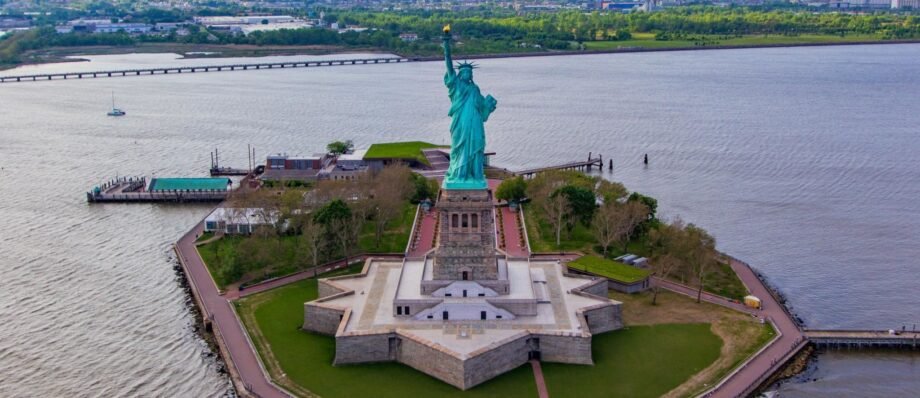
Statue of Liberty, New York
The Statue of Liberty is one of the world’s most recognizable landmarks and a defining symbol of New York City, freedom, democracy, and immigration. Standing on Liberty Island in New York Harbor, the monumental copper statue has welcomed visitors and newcomers to the United States for more than a century.
Officially named “Liberty Enlightening the World” (La Liberté éclairant le monde), the statue was a gift from France to the United States and was dedicated on October 28, 1886.
Quick Facts
| Information | Details |
|---|---|
| Official name | Liberty Enlightening the World |
| Location | Liberty Island, New York Harbor |
| City | New York City, New York, USA |
| Dedicated | October 28, 1886 |
| Sculptor | Frédéric Auguste Bartholdi |
| Structural engineer | Gustave Eiffel and his team |
| Material | Copper exterior over an iron/steel framework |
| Height | About 305 ft (93 m) from ground to torch |
| Pedestal | About 154 ft (47 m) |
| Torch | Original torch replaced in 1986 |
| UNESCO status | UNESCO World Heritage Site |
| National Park | Statue of Liberty National Monument |
History
The Statue of Liberty was conceived in France during the 19th century as a monument celebrating liberty and the relationship between France and the United States.
French political thinker and abolitionist Édouard René de Laboulaye was an important supporter of the idea. Sculptor Frédéric Auguste Bartholdi subsequently developed the monument’s design.
Construction took place in France, where the statue was assembled in sections. It was then dismantled and transported across the Atlantic to New York.
The statue was reassembled on what was then called Bedloe’s Island, now Liberty Island. Its dedication ceremony took place on October 28, 1886.
The monument quickly became associated with America’s ideals of liberty and with the millions of immigrants who arrived in New York Harbor during the great immigration era.
What Does the Statue of Liberty Represent?
The statue’s symbolism is deliberately powerful.
Lady Liberty holds a torch in her raised right hand, representing enlightenment and freedom. In her left hand is a tablet inscribed:
JULY IV MDCCLXXVI
This represents July 4, 1776, the date of the United States Declaration of Independence.
At her feet are broken chains, symbolizing freedom from oppression.
The seven rays of her crown are commonly interpreted as representing the seven seas and seven continents.
The Statue’s Design
The Statue of Liberty is a remarkable engineering achievement for its era.
Bartholdi designed the monumental exterior while the internal structural system was developed with assistance from engineer Gustave Eiffel, who later became famous for the Eiffel Tower.
The exterior consists of thin sheets of copper. Rather than being a solid copper sculpture, the statue is essentially a copper skin supported by an internal framework.
The copper originally had a reddish-brown appearance. Over the decades, exposure to air and moisture caused the copper to oxidize and develop its distinctive green patina.
This patina is not simply decorative. It also provides a protective layer over the underlying copper.
How Tall Is the Statue of Liberty?
From the foundation to the top of the torch, the monument is approximately 305 feet (93 meters) tall.
The statue itself, measured from heel to top of head, is approximately 111 feet (34 meters) tall.
The pedestal adds substantially to the monument’s overall height.
The statue was among the world’s most impressive monumental sculptures when it was completed in the 19th century.
Liberty Island
Liberty Island is the small island in New York Harbor on which the Statue of Liberty stands.
Visitors can explore the island, walk around the monument, visit the Statue of Liberty Museum, and enjoy views of Manhattan, Brooklyn, New Jersey, and New York Harbor.
The island is administered as part of the Statue of Liberty National Monument by the U.S. National Park Service.
Statue of Liberty Museum
The Statue of Liberty Museum provides an in-depth look at the monument’s history, construction and symbolism.
Exhibits explore:
- The origins of the statue
- Bartholdi’s design
- Construction in France
- Transportation to America
- The engineering behind the monument
- The statue’s changing appearance
- Immigration and the statue’s relationship with New York Harbor
- The evolution of Liberty’s symbolism
One of the museum’s notable objects is the original torch, which was replaced during the major restoration of the monument in the 1980s.
The Pedestal
The pedestal is an important part of the Statue of Liberty experience.
Visitors with the appropriate ticket can enter the pedestal and climb to an observation area. From here, there are views across New York Harbor and toward Manhattan.
The pedestal also contains exhibits and historical information.
Because capacity is limited, access to the pedestal generally requires advance planning.
The Crown
One of the most popular experiences is visiting the crown.
The crown contains 25 windows and offers views through the statue’s head toward New York Harbor.
Visitors must climb a long internal staircase to reach the crown. Access is limited and requires a specific reservation.
The crown is considerably more difficult to access than the island and museum, so travelers should plan ahead if this is an important part of their visit.
Getting to the Statue of Liberty
The primary visitor ferry service operates from Manhattan and New Jersey.
From Manhattan, visitors commonly depart from The Battery at the southern end of Manhattan. Ferries travel to both Liberty Island and nearby Ellis Island.
A typical visit can include:
Battery → Liberty Island → Ellis Island → Battery
The ferry ride itself is also part of the experience, providing excellent views of the Statue of Liberty and the Manhattan skyline.
Important ticket advice
Visitors should distinguish between official Statue of Liberty ferry services and unofficial sightseeing boats.
For access to the island, the official concessioner is Statue City Cruises. Advance reservations are recommended, particularly for pedestal and crown access.
Statue of Liberty and Ellis Island
The Statue of Liberty and Ellis Island are closely connected in the history of immigration to the United States.
Ellis Island served as the country’s major federal immigration processing station from 1892 to 1954. More than 12 million immigrants passed through the facility during its years of operation.
The Statue of Liberty itself was not an immigration processing station, but its location in New York Harbor made it a powerful landmark for people arriving in America.
Today, many visitors combine the two sites in a single trip.
Best Views of the Statue of Liberty
You do not necessarily have to visit Liberty Island to see the statue.
Some excellent viewpoints include:
- Battery Park – close views from Lower Manhattan
- The Staten Island Ferry – views of the statue while crossing the harbor
- Brooklyn Bridge area – statue and harbor views
- Brooklyn Bridge Park – excellent skyline-and-harbor photography
- One World Observatory area – distant views from Lower Manhattan
- New York Harbor sightseeing cruises – different perspectives from the water
Best Time to Visit
The Statue of Liberty can be visited throughout the year, but conditions vary considerably by season.
Spring: Comfortable temperatures and generally good conditions for walking around Liberty Island.
Summer: Long daylight hours but heavier crowds and potentially hot weather.
Autumn: Often an excellent combination of comfortable weather, attractive light and changing seasonal conditions.
Winter: Fewer tourists are possible, but cold temperatures and harbor weather can make the experience less comfortable.
For photography, morning can provide attractive light and relatively comfortable conditions, while late afternoon can offer beautiful views toward Manhattan.
How Long Should You Spend There?
Allow approximately 3–5 hours if you want to visit Liberty Island and Ellis Island without rushing.
A simple Liberty Island visit can take around 2–3 hours, depending on ferry schedules and whether you visit the museum.
If you also visit Ellis Island, plan for additional time.
Visitors with crown reservations should allow extra time because of the security procedures and staircase climb.
Nearby Attractions
The Statue of Liberty is located in one of New York’s most historically important areas.
Nearby attractions include:
- Ellis Island
- Battery Park
- Wall Street
- 9/11 Memorial & Museum
- One World Trade Center
- Brooklyn Bridge
- South Street Seaport
- Brooklyn Bridge Park
- Governors Island
This makes Lower Manhattan an excellent area for combining several major attractions in one day.
Photography
The Statue of Liberty is particularly photogenic from the water.
For classic photographs, try:
- Ferry approaches to Liberty Island
- The Manhattan skyline behind the statue
- Sunset views from New York Harbor
- Wide-angle photographs from Liberty Island
- Close architectural details of the face, crown and torch
- Long-distance views from Brooklyn
A wide-angle lens is useful for photographing the entire monument from relatively close range.
Visiting Tips
Book ahead. Crown and pedestal tickets are limited.
Allow time for security. Security screening is required before boarding the ferry and entering restricted areas.
Wear comfortable shoes. Liberty Island involves walking, and the crown requires climbing stairs.
Check the weather. Harbor conditions can affect ferry operations and comfort.
Consider visiting Ellis Island. It adds historical depth to a Statue of Liberty visit.
Do not underestimate the ferry schedule. Allow enough time between island visits and your return to Manhattan or New Jersey.
Why Visit the Statue of Liberty?
The Statue of Liberty is much more than a famous photograph.
It combines art, engineering, American history, French-American relations, immigration history and New York Harbor’s maritime heritage in one landmark.
For first-time visitors to New York City, standing beneath the enormous copper figure on Liberty Island provides a very different experience from seeing it from Manhattan. The scale of the monument becomes much more apparent, while the surrounding harbor provides spectacular views of the city.
Whether you visit the crown, explore the museum, walk around the island, or simply take the ferry for harbor views, the Statue of Liberty remains one of the essential experiences in New York City.