Franklin Square in Philadelphia: History, Attractions, Activities and Visitor Guide
Franklin Square is one of Philadelphia’s five original public squares and one of the most interesting green spaces in the historic heart of the city. Located in the Old City area at 200 N 6th Street, the square combines Philadelphia’s colonial history with family attractions, gardens, fountains, miniature golf, a carousel, seasonal events, and views toward the Benjamin Franklin Bridge.
Unlike some of Philadelphia’s historic sites, Franklin Square is not simply a place to look at monuments. It is a living urban park where history, recreation, landscape design, and tourism come together.
The square has undergone many transformations since the 18th century. It was once used as pasture, a marketplace, a cemetery, a military parade and drill ground, and eventually a public park. Its name was officially changed to Franklin Square in 1825, honoring Philadelphia’s famous statesman, inventor, printer, scientist, and Founding Father Benjamin Franklin.
Today, Franklin Square provides a particularly appealing stop for travelers exploring Philadelphia’s historic district, especially families and visitors who want to combine sightseeing with outdoor activities.
Where Is Franklin Square?
Franklin Square is located in Old City Philadelphia, immediately north of the core Independence National Historical Park area.
The square occupies the block bounded approximately by:
- 6th Street
- 7th Street
- Race Street
- Arch Street
Its central location makes it easy to incorporate into a walking tour of Philadelphia’s historic attractions.
Nearby landmarks include:
- Independence Hall
- Liberty Bell Center
- Independence Visitor Center
- National Constitution Center
- Betsy Ross House
- Elfreth’s Alley
- Christ Church
- Benjamin Franklin’s grave at Christ Church Burial Ground
- National Constitution Center
- Benjamin Franklin Bridge
Franklin Square is therefore particularly useful as a break between visits to Philadelphia’s major historical attractions.
A Brief History of Franklin Square
Philadelphia’s Original Urban Plan
Franklin Square is one of the five original public squares incorporated into William Penn’s plan for Philadelphia.
Penn envisioned Philadelphia as a “green country town,” incorporating open spaces into the developing city. The five original squares were:
- Centre Square – approximately where Philadelphia City Hall stands today
- Rittenhouse Square
- Logan Square
- Washington Square
- Franklin Square
The squares were intended to provide open, green areas within the expanding urban settlement.
Franklin Square eventually became particularly associated with the neighborhoods developing east of the original city center and close to the Delaware River.
From Pasture to Public Space
Franklin Square’s early history was considerably less peaceful and picturesque than its modern appearance suggests.
According to National Park Service historical documentation, the square was used at different times as:
- cattle pasture
- a horse and cattle market
- a burial ground
- a military drill and parade ground
- a city park
During the American Revolution, a powder house was also constructed on the square for military purposes. Part of the square was used as a cemetery by the German Reform Church between 1741 and 1835.
This mixture of commercial, military, religious, and recreational uses illustrates how Philadelphia’s public spaces evolved alongside the city’s rapidly changing population.
Why Is It Called Franklin Square?
The square was originally known as Northeast Square.
Its name was officially changed to Franklin Square in 1825, in honor of Benjamin Franklin.
The choice was particularly appropriate because Franklin was one of the most important figures in Philadelphia’s history.
Franklin spent much of his life in the city and was deeply involved in:
- science
- printing
- publishing
- civic improvements
- education
- diplomacy
- politics
- the American Revolution
- the development of Philadelphia’s intellectual institutions
Franklin’s presence can be felt throughout the surrounding neighborhood. His former home site is preserved at nearby Franklin Court, part of Independence National Historical Park.
Franklin Square and the 19th Century
During the 19th century, Franklin Square gradually developed into a landscaped urban park.
The city enclosed and leveled the square in 1815, with grass and trees planted around the same time. In 1824, architect and sculptor William Rush prepared a plan featuring paths, trees, and a central fountain.
In 1837, Franklin Square was illuminated with gas lighting and opened at night. A new marble central fountain was also installed.
Historical illustrations from the 1830s show a landscaped park containing:
- shade trees
- paved walking paths
- benches
- lighting
- a central circular fountain
- a small guard house
In 1883, the perimeter fence was removed and the grounds were redesigned.
These developments helped transform Franklin Square into the kind of public recreational space that Philadelphians recognize today.
Franklin Square Today
Today, Franklin Square is operated as a public park and family-oriented attraction within Philadelphia’s historic district.
Franklin Square combines traditional park features with attractions designed specifically for visitors.
Among its principal attractions are:
- Parx Liberty Carousel
- Franklin Square Mini Golf
- Swings
- Fountain
- landscaped gardens
- walking paths
- children’s activities
- seasonal entertainment
- food and refreshments
Its location also makes it a convenient place to relax during a longer Old City sightseeing itinerary.
The Parx Liberty Carousel
One of Franklin Square’s most recognizable attractions is the Parx Liberty Carousel.
The carousel provides a distinctly family-friendly element within a neighborhood dominated by historic buildings and museums.
The attraction is particularly popular with children, although adults can enjoy it as part of a nostalgic visit to the park.
Its presence also reinforces the idea that Franklin Square is more than a historical landscape. It is intended to be an active recreational destination.
Franklin Square Mini Golf
One of the most unusual attractions in the park is Franklin Square Mini Golf.
Rather than functioning simply as a conventional miniature golf course, the attraction incorporates Philadelphia themes into its design.
Players can encounter representations inspired by the city’s architecture and landmarks while moving through the course.
This makes mini golf an especially good activity for families who may not want to spend the entire day visiting museums.
It is also a fun way to introduce younger visitors to Philadelphia’s history without turning the entire visit into a formal historical tour.
The Franklin Square Fountain
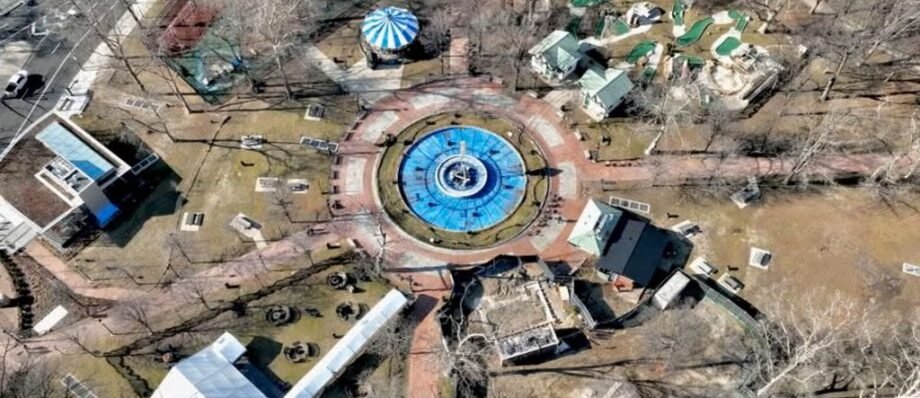
At the center of the park is its historic fountain, which has long served as an important visual feature of the square.
The present landscape reflects the long tradition of fountains and landscaped public spaces associated with Franklin Square.
The fountain creates an attractive focal point surrounded by paths, lawns, gardens, and seating.
It is particularly pleasant during warmer months when visitors can use the surrounding park as a place to relax between sightseeing stops.
Gardens and Green Space
Although Philadelphia is famous for its historic architecture, Franklin Square demonstrates another side of the city.
The park provides:
- mature trees
- lawns
- landscaped areas
- pedestrian paths
- shaded seating
- open recreational space
This makes it a useful place for travelers who have spent several hours walking around Old City.
The square’s landscaping also connects it with the broader tradition of Philadelphia’s historic public squares.
Family-Friendly Activities
Franklin Square is one of the better historic-district destinations for families because children can do more than simply look at historical buildings.
Activities may include:
Carousel rides
The Parx Liberty Carousel provides a traditional amusement-park experience.
Mini golf
The Philadelphia-themed course offers an interactive activity suitable for families and groups.
Walking
The paths provide an easy way to explore the park without committing to a formal tour.
Playing and relaxing
Children can enjoy the recreational areas while adults relax in the surrounding gardens.
Seasonal events
Franklin Square regularly hosts seasonal programming and special activities, making the character of the park different at different times of year.
Franklin Square During the Holidays
Franklin Square becomes particularly attractive during the holiday season.
One of the park’s best-known seasonal traditions is its holiday light programming, when the square is transformed with illuminated displays.
The combination of:
- historic Philadelphia surroundings
- decorative lighting
- music
- the fountain
- trees
- family activities
creates a very different atmosphere from the park’s daytime summer appearance.
For travelers visiting Philadelphia in late autumn or winter, Franklin Square can therefore be worth visiting even if they have already explored the square during another season.
Franklin Square and Benjamin Franklin
The relationship between Franklin Square and Benjamin Franklin is symbolic rather than based on the square being Franklin’s former residence.
For a deeper look at Franklin’s personal life, visitors should continue south toward Franklin Court.
Franklin Court contains the archaeological remains and “ghost structures” associated with Franklin’s former home, along with the Benjamin Franklin Museum and the Franklin Court Printing Office.
This makes it easy to combine Franklin Square with Franklin Court in the same walking itinerary.
Nearby Historic Attractions
One of the greatest advantages of Franklin Square is its proximity to some of the most important historical sites in the United States.
Independence Hall
Independence Hall is only a short walk from Franklin Square.
The building is central to the history of the United States because both the Declaration of Independence and U.S. Constitution are associated with its historic rooms.
The surrounding Independence National Historical Park contains more than 54 acres of historic sites and public spaces.
Liberty Bell
The Liberty Bell Center is another essential attraction nearby.
Visitors can see the famous bell and learn about its changing historical symbolism.
The National Park Service currently lists the Liberty Bell Center as open daily, with visitor hours generally extending from morning through late afternoon.
Independence Square
Independence Square is particularly important to American political history.
The square was a gathering place before and during the American Revolution. On July 8, 1776, the Declaration of Independence was publicly read there.
The location subsequently remained associated with political activism and public demonstrations.
Frederick Douglass spoke at an antislavery event on Independence Square in 1844, demonstrating how the site continued to be used for debates about freedom and civil rights long after the Revolution.
National Constitution Center
The National Constitution Center is located close to Franklin Square and provides an excellent complement to Philadelphia’s Revolutionary-era sites.
It focuses on the Constitution, American government, constitutional interpretation, and civic history.
Betsy Ross House
The Betsy Ross House is another popular Old City attraction.
It is associated with Betsy Ross and the long-standing American tradition surrounding the creation of the first U.S. flag.
Its location makes it easy to combine with Franklin Square, Elfreth’s Alley, and other Old City attractions.
Elfreth’s Alley
Elfreth’s Alley is one of Philadelphia’s most distinctive historic streets.
Its narrow residential character offers a striking contrast with the broad public spaces and monumental buildings around Independence Mall.
It is an excellent addition to a walking tour beginning at Franklin Square.
Franklin Square and Philadelphia’s Historic District
Franklin Square is particularly valuable because it sits at the intersection of several different aspects of Philadelphia’s history.
A short walk around the neighborhood can reveal:
- colonial Philadelphia
- the American Revolution
- the founding of the United States
- early American government
- Benjamin Franklin’s legacy
- African American history
- religious history
- commercial history
- 19th-century urban development
- modern tourism
This concentration of historical layers is one of the reasons Old City is so important to Philadelphia’s tourism industry.
Independence National Historical Park itself includes Independence Hall, the Liberty Bell, Congress Hall, Franklin Court, Washington Square, and numerous other historic locations.
Franklin Square for Families
Franklin Square is especially attractive for families visiting Philadelphia.
A typical family sightseeing day can otherwise involve long periods inside museums and historic buildings. Franklin Square offers a change of pace.
Children can:
- ride the carousel
- play mini golf
- walk around the gardens
- enjoy open space
- participate in seasonal activities
Parents can combine these activities with visits to major historic attractions.
For families with young children, this makes Franklin Square a useful stop rather than simply another historical site to photograph.
Franklin Square for Couples
Couples can also enjoy the park, particularly during quieter periods.
The landscaped paths, fountain, trees, and historic surroundings provide a pleasant environment for:
- relaxed walks
- photography
- sitting outdoors
- casual dates
- combining sightseeing with a break
During seasonal events, the atmosphere can become considerably more lively.
Franklin Square for Photographers
Franklin Square offers a variety of photographic subjects.
Good subjects include:
- the central fountain
- landscaped pathways
- mature trees
- historic surrounding architecture
- the Parx Liberty Carousel
- mini golf
- Benjamin Franklin Bridge views
- seasonal decorations
- evening illumination
The park can also serve as a useful photographic location for capturing the contrast between Philadelphia’s historic urban environment and modern attractions.
Best Time to Visit
The best time to visit depends on what you want to experience.
| Season | What to Expect |
|---|---|
| Spring | Trees, gardens and pleasant walking conditions |
| Summer | Outdoor activities, families, long daylight hours |
| Autumn | Cooler weather and changing foliage |
| Winter | Holiday atmosphere and seasonal lighting |
| Weekday mornings | Generally more relaxed sightseeing |
| Weekend afternoons | More family activity and visitors |
| Evening | Attractive atmosphere when seasonal lighting and events are operating |
For a quieter experience, morning or early afternoon on a weekday can be preferable.
How Long Should You Spend at Franklin Square?
The appropriate amount of time depends on whether you are simply sightseeing or participating in the attractions.
Quick visit: 20–30 minutes
Suitable for:
- walking around
- seeing the fountain
- taking photographs
- enjoying the landscape
Standard visit: 1–2 hours
Suitable for:
- exploring the park
- riding the carousel
- playing mini golf
- relaxing
Family visit: 2–3 hours
Allow more time if children want to participate in several activities.
Franklin Square can also be incorporated into a much longer Old City itinerary.
Suggested Old City Walking Route
A useful itinerary could be:
Franklin Square → National Constitution Center → Independence Hall → Liberty Bell → Independence Square → Franklin Court → Christ Church → Elfreth’s Alley → Betsy Ross House
This route combines recreation, architecture, American history, and some of Philadelphia’s most famous landmarks.
Because many of these attractions are relatively close together, Old City is particularly well suited to exploration on foot.
Franklin Square and the Benjamin Franklin Bridge
One of the park’s most interesting visual connections is with the Benjamin Franklin Bridge.
The bridge crosses the Delaware River and connects Philadelphia with Camden, New Jersey.
Its large suspension structure provides an impressive backdrop from portions of Franklin Square and the surrounding Old City streets.
This is another reason the park can be interesting for photographers and visitors who want to experience Philadelphia beyond its most famous colonial buildings.
Historical Importance
Franklin Square’s importance is not based on a single famous event.
Instead, its historical significance comes from its long evolution as a public space.
It has served as:
Pasture → Marketplace → Cemetery → Military Ground → Urban Park → Family Recreation Destination
That transformation mirrors the development of Philadelphia itself.
The square demonstrates how an urban space can acquire new purposes without completely losing its historical identity.
Franklin Square Compared With Philadelphia’s Other Historic Squares
| Square | Main Character |
|---|---|
| Franklin Square | Family recreation, history, fountain and attractions |
| Washington Square | Revolutionary history, memorials and landscaped park |
| Rittenhouse Square | Upscale urban park, dining and shopping |
| Logan Square | Cultural institutions, gardens and major museums |
| Former Centre Square area | Modern civic center around Philadelphia City Hall |
Franklin Square stands out because of its combination of history and family entertainment.
Practical Visitor Information
Franklin Square is located at:
200 N 6th Street, Philadelphia, PA 19106
The park is within easy walking distance of many Old City attractions.
The National Park Service’s nearby Independence National Historical Park visitor facilities provide information for exploring the surrounding historic district. The Independence Visitor Center is currently listed as open daily from 9:00 a.m. to 6:00 p.m., with the National Park Service desk closing at 5:00 p.m.
Because Franklin Square’s individual attractions and seasonal programs can have different operating schedules, visitors should check current attraction information before planning a specific activity.
Tips for Visiting Franklin Square
1. Combine it with Old City
Don’t treat Franklin Square as an isolated destination. Its location makes it ideal as one stop within a broader historic walking tour.
2. Allow extra time with children
If traveling with children, plan additional time for the carousel and mini golf.
3. Check seasonal programming
The character of Franklin Square can change considerably during holiday periods and special events.
4. Visit early for a quieter experience
Morning visits can provide a more relaxed atmosphere than busy weekend afternoons.
5. Wear comfortable shoes
Franklin Square is most useful when combined with Philadelphia’s nearby historic attractions, many of which are best explored on foot.
6. Explore the surrounding streets
Some of Philadelphia’s most interesting historic architecture is found not inside the major attractions but along the streets connecting them.
7. Combine Franklin Square with Franklin Court
Because both locations are connected to Benjamin Franklin’s legacy, visiting them together provides a stronger understanding of his importance to Philadelphia.
Why Franklin Square Is Worth Visiting
Franklin Square may not have the international fame of the Liberty Bell or Independence Hall, but that is precisely part of its appeal.
It provides a different experience of Philadelphia.
Here, visitors can move from the history of the American Revolution to a landscaped urban park, from Benjamin Franklin’s legacy to family entertainment, and from historic architecture to modern recreational attractions within a relatively small area.
Its history is unusually diverse. The square has been a pasture, marketplace, cemetery, military ground, landscaped park, and recreational destination. Its transformation reflects more than two centuries of Philadelphia’s urban development.
For tourists exploring Philadelphia’s Old City, Franklin Square is therefore best understood not simply as a park, but as a historic public space that connects Philadelphia’s colonial past with its modern city life.
Franklin Square at a Glance
| Category | Information |
|---|---|
| Location | Old City, Philadelphia |
| Address | 200 N 6th Street, Philadelphia, PA 19106 |
| Historic name | Northeast Square |
| Renamed | 1825 |
| Named after | Benjamin Franklin |
| Original city plan | William Penn’s Philadelphia |
| Major attractions | Fountain, Parx Liberty Carousel, Mini Golf |
| Best for | Families, history, walking, photography |
| Nearby | Independence Hall, Liberty Bell, Franklin Court, Betsy Ross House, Elfreth’s Alley |
| Character | Historic urban park + family attraction |
| Recommended visit | 1–2 hours, or longer with children |
In short: Franklin Square is one of Philadelphia’s most appealing lesser-known historic destinations. It offers an unusually successful combination of American history, Benjamin Franklin’s legacy, landscaped public space, family entertainment, and Old City sightseeing, making it a worthwhile addition to almost any Philadelphia itinerary.